ET IN ARCADIA EGO
Et in Arcadia Ego, the new performance project by Arkadi Zaides, takes as its starting point Nicolas Poussin’s eponymous seventeenth-century painting. It depicts a pastoral scene in which four characters gather around a tomb, contemplating its cryptic Latin inscription, "Et in Arcadia Ego", often translated as “Even in Arcadia, I exist”. This serene composition juxtaposes the idealized beauty of Arcadia with the inescapable reality of mortality, serving as a memento mori. It invites viewers to ponder whether Arcadia - an imagined paradise - offers the promise of immortality or stands as a reminder of mortality’s dominion, even in utopia.
Since its creation, the painting has served as a point of reference for numerous artists who have reinterpreted its imagery, injecting their own meanings in relation to the historical, political, and social conditions of their time. These interpretations, mostly within the filed of visual arts, often transpose Poussin’s symbolic landscape into charged contexts, using it as a lens through which to critique militarism, nationalism, environmental collapse, and systems of exclusion. Et in Arcadia Ego has thus, over the decades and centuries, become a shifting metaphor - its pastoral harmony fractured by real-world events that destabilize our notions of paradise.
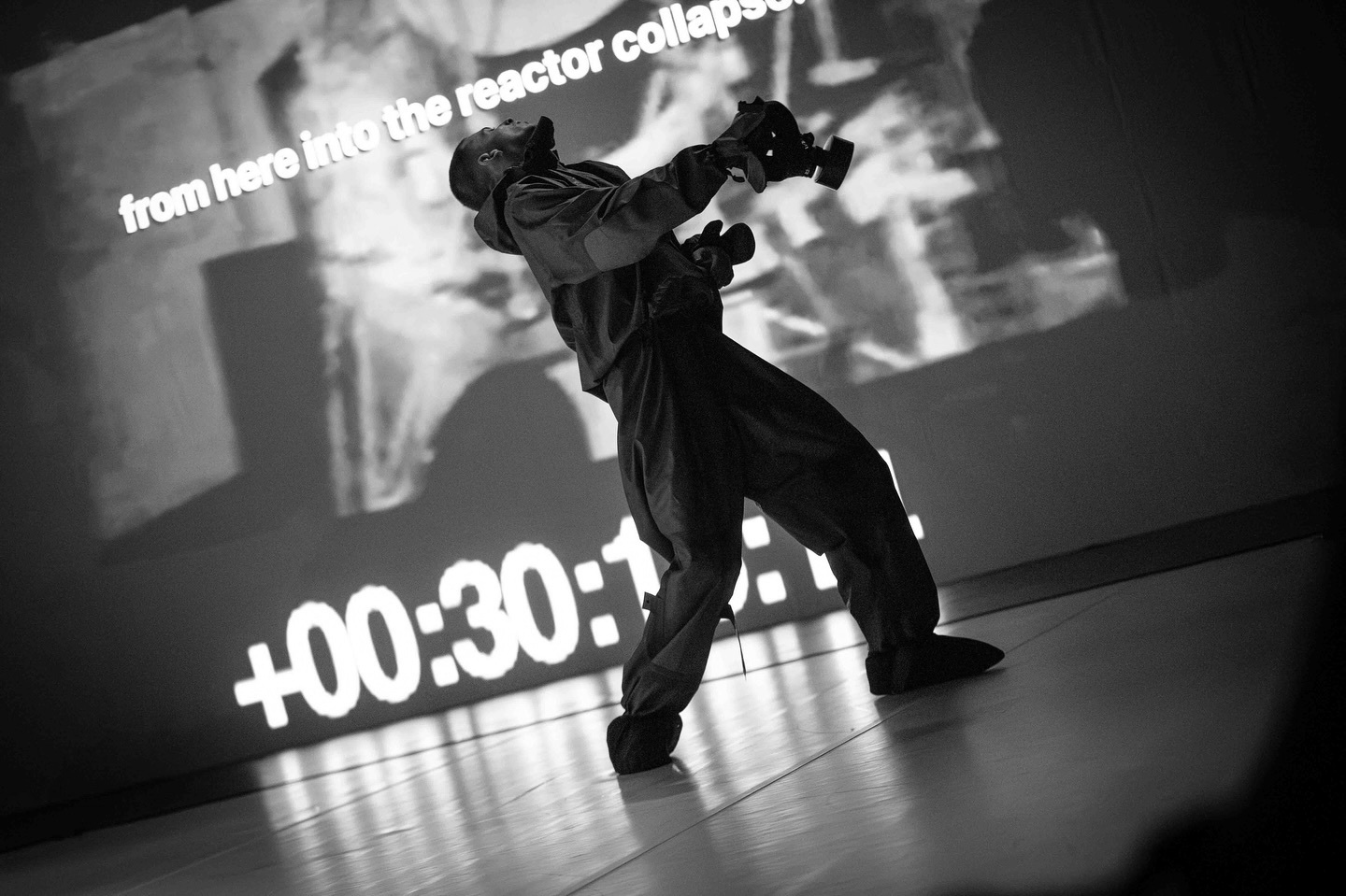
Zaides' project reopens this metaphor by transposing Poussin’s static tableau into the realm of live performance, where new resonances emerge through distinct responses by four artists/perfromers. Rather than reconstructing the scene, each artist approaches it through a singular hybrid practice, opening the image to different histories, forms of knowledge, and ways of seeing. Drawing on their respective artistic approaches, they raise key questions: How does Poussin’s pastoral vision resonate today, in a world where utopia is increasingly promised to some while death is inflicted upon others? How can multiple artistic practices and geopolitical perspectives transform a single image into a space for divergent narratives? And what constraints and possibilities emerge when live performance is used to engage with an analogue medium - specifically, a seventeenth-century painting?
Credits & Collaborators
Choreography & direction Arkadi Zaides Dramaturgy Igor Dobričić Performers Igor Dobričić, Olivier Marboeuf, Lázara Rosell Albear, Arkadi Zaides, 1 more performer tbc. Administration and production Simge Gücük/Institut des Croisements (FR) Executive producer laGeste (BE) Co-produced by Agora, Cité Internationale de la Danse (FR), Charleroi Danse (BE), STUK (BE), Orbita | Spellbound National Production Center for Dance (IT), La Place de la Danse CDCN Toulouse Occitanie in the frame of accueil-studio (FR), Künstler*innenhaus Mousonturm Frankfurt am Main (DE) Research support La Vignette, scène conventionnée, Université Paul-Valéry Montpellier (FR), DRAC Occitanie and the Occitanie Region (FR), Arkadi Zaides is associate artist at Agora, Cité Internationale de la Danse (FR). For this creation, he is hosted at Agora, Cité Internationale de la Danse with the support of the Fondation BNP Paribas (FR)Upcoming
Past Events